
Insights · 2026-10-18
Restructuring of Mixed Sales Rules | VAT Tax Pitfalls for Elevator Enterprises
I. Mixed Sales Become History: The "Principal–Accessory Relationship" Is Now the Deciding Factor
1.1 Prior Mixed Sales Rules: VAT Rate Determined by the Enterprise’s Principal Business
Before 2026, the taxation treatment for a transaction involving both goods and services was mainly governed by Caishui [2016] No. 36. Under the mixed sales rules, the applicable VAT rate was determined by the taxpayer’s principal business: entities primarily selling goods were taxed at 13%, while those mainly providing services applied the 6% or 9% rate.
This rule appeared straightforward but was in fact fraught with loopholes:
- Ambiguous judging criteria: What constitutes "principally engaged in the production, wholesale or retail of goods"? Should the determination rely on business license, revenue proportion or profit composition? Tax authorities held inconsistent positions across jurisdictions.
- Ample room for discretionary manipulation: Enterprises could “select” their principal business by adjusting business structures, and thereby choose the applicable VAT rate.
- Particular dilemma for the elevator industry: Elevator companies sell, install and maintain elevators all together. What exactly qualifies as their principal business?
1.2 Current Mixed Sales Regime: VAT Rate Determined by Substance of Transaction
Effective 1 January 2026, Article 13 of the Value-Added Tax Law comes into force: Where a taxpayer conducts a taxable transaction involving two or more tax rates or levy rates, the applicable tax rate or levy rate shall be determined based on the principal business of such taxable transaction.
Article 10 of the Regulations for the Implementation of the Value-Added Tax Law further clarifies that two conditions must be satisfied simultaneously for the determination criteria:
The taxable transaction referred to in Article 13 of the VAT Law shall meet both of the following requirements:
(1) It comprises two or more businesses subject to different tax rates or levy rates;
(2) There is a clear primary-accessory relationship among the businesses. The principal business occupies the dominant position and reflects the substance and purpose of the transaction; the accessory business serves as a necessary complement to the principal business and is conditional upon the occurrence of the principal business.
II. Elevator Sales + Installation
2.1 “Tax-Splitting Benefits” under the Old Rules
Prior to 2026, a widely adopted tax-saving arrangement existed in the elevator industry:
Enterprises would enter into a separate elevator sales contract (13% VAT rate) and a standalone installation service contract (9% VAT rate or 3% under simplified taxation), with separate accounting and separate invoicing for financial purposes.
This practice was supported by Announcement No. 11 of 2017 and Announcement No. 42 of 2018 issued by the State Taxation Administration:
Where sales of goods such as prefabricated houses, machinery and equipment, and steel structures are accompanied by the provision of construction and installation services, such transactions shall not be treated as mixed sales. The sales amounts of goods and construction services shall be accounted for separately, with different applicable tax rates or levy rates respectively.
2.2 "Uniform Higher Rate Application" under the New Rules
Effective 1 January 2026, Article 3 of the Announcement of the Ministry of Finance and the State Taxation Administration on Matters Concerning VAT Input Tax Deduction and Other Related Issues (Announcement No.13 of 2026) stipulates clearly:
Installation services provided concurrently with the sale of goods such as prefabricated houses, machinery and equipment, and steel structures shall be subject to the VAT rate applicable to such goods.
In an official response issued in June 2026, the State Taxation Administration further confirmed:
The sale of machinery and equipment occupies the dominant position and reflects the substance and purpose of the transaction. The installation service constitutes a necessary complement and is conditional upon the sale of machinery and equipment. Therefore, the transaction shall apply the 13% VAT rate corresponding to the principal business of "sale of goods".
2.3 Response Strategies for Elevator Enterprises
(1) Restructure business models
-
Employer-supplied materials projects: The customer purchases elevators on its own (employer-supplied materials), while the elevator company only provides installation services. Under this scenario, the installation may qualify for 3% simplified taxation. However, such simplified taxation policies have been significantly tightened; the option is only available for pure labour contracts and old projects commenced on or before 30 April 2016.
-
Separate principal entities: Establish independent legal entities to undertake sales and installation services respectively. It should be noted that genuine commercial transactions must exist between the two entities. Related-party round-tripping transactions are not permissible, otherwise the arrangement may be deemed a sham transaction.
(2) Tax burden pass-through
A more pragmatic approach is to incorporate the incremental tax burden into the pricing model and negotiate adjustments to the total contract value with customers. Given that the entire industry faces the same VAT rate changes, customers will have a certain degree of acceptance for price adjustments.
Meanwhile, where a single contract covers multiple types of services, itemise the consideration for each business component as far as practicable. Even though sales-plus-installation transactions are subject to a uniform 13% VAT rate under the new 2026 VAT Law, separate price breakdowns still help substantiate the transaction structure and preserve room for potential future policy changes or tax disputes.
IV. Leasing of Elevator Advertising Spaces (Operating Lease)
Pursuant to Annex 1 Notes on Sales of Services, Intangible Assets and Real Property of the Circular of the Ministry of Finance and the State Taxation Administration on the Full Roll-out of the Pilot Program for Replacing Business Tax with VAT (Caishui [2016] No. 36):
Leasing advertising spaces on real property such as buildings and structures, or tangible movable property such as aircraft and vehicles, to other entities or individuals for advertisement publication shall be subject to VAT as operating lease services.
Elevator advertising spaces are attached to buildings (elevator shafts and car cabins form integral parts of buildings), and therefore qualify as operating lease services of real property.
Distinction from Advertising Services:
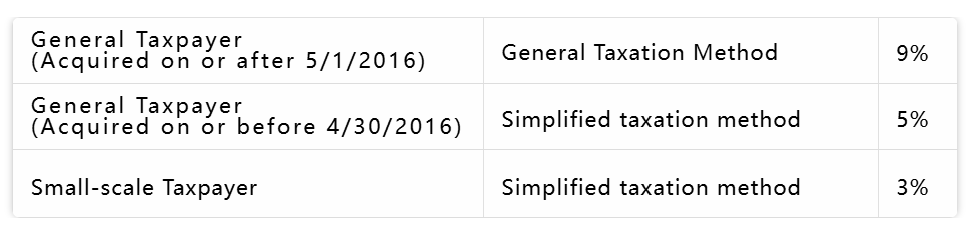
Leasing of advertising spaces: Only provision of advertising spaces without advertisement creation, publication or agency. Classified as operating lease of real property, applicable VAT rate is 9% (or 5% / 3%).
Advertising services: Covering advertisement design, production, publication and agency. Classified as cultural and creative services, applicable VAT rate is 6%.
Related insights
- 2026-09-09Lessons Learned from the Wesley Trust Case and the Interpretation of the New Domestic Circular No. 21
- 2026-08-27State Taxation Administration Issues Document Clarifying Collection and Administration Issues Concerning Income Tax Treatment of Enterprise Reorganization
- 2026-07-27【BREAKING】New Offshore Trust Rules