
Insights · 2023-07-18
Tax-payment credit rating — an essential pillar of enterprise risk control

By Danyi Yang
A wide range of national and provincial regulations taking effect from 1 July 2023 touch on the concept of "credit rating". Below is a quick survey of the most relevant ones.
Regulations taking effect on 1 July 2023
Measures for the Administrative Supervision of Contracts (《合同行政监督管理办法》). Article 4 requires that business operators conclude contracts in accordance with the principles of equality, voluntariness, fairness and good faith, and may not use contracts to harm the interests of the State, the public interest, or the legitimate rights and interests of consumers. Article 20 requires market-supervision authorities to publish administrative penalties through the National Enterprise Credit Information Publicity System.
Measures for the Risk Classification of Commercial Bank Financial Assets (《商业银行金融资产风险分类办法》). Article 3 requires commercial banks to risk-classify on-balance-sheet credit-risk-bearing financial assets, including (without limitation) loans, bonds and other investments, interbank assets and receivables, and to apply the same standard to off-balance-sheet items that bear credit risk.
Regulations on the Administration of Commercial Cryptography (《商用密码管理条例》). Article 46 calls for cryptography authorities to align commercial-cryptography supervision with the social credit system — establishing credit records, graded and classified supervision, discipline for untrustworthy conduct, and credit-repair mechanisms.
Local social-credit rules have also been updated in Ningbo, Xiamen, Foshan and several districts/counties, alongside updated evaluation indicators for government-integrity demonstration enterprises.
The Corporate Social Credit System (CSCS)
The concept of a unified Corporate Social Credit System (CSCS) was first raised in the 1990s, with the system formally launched in 2014. It aggregates data from cyberspace administration, civil affairs, customs, justice, market supervision, finance, environment and transport authorities to assess every enterprise and individual registered in China. The objective is to use big data to make each entity's operating conditions publicly available, strengthening government oversight of day-to-day economic activity and providing shared, trustworthy credit information in support of a stable market economy.
Public-facing components of the CSCS
National Enterprise Credit Information Publicity System (国家企业信用信息公示系统)
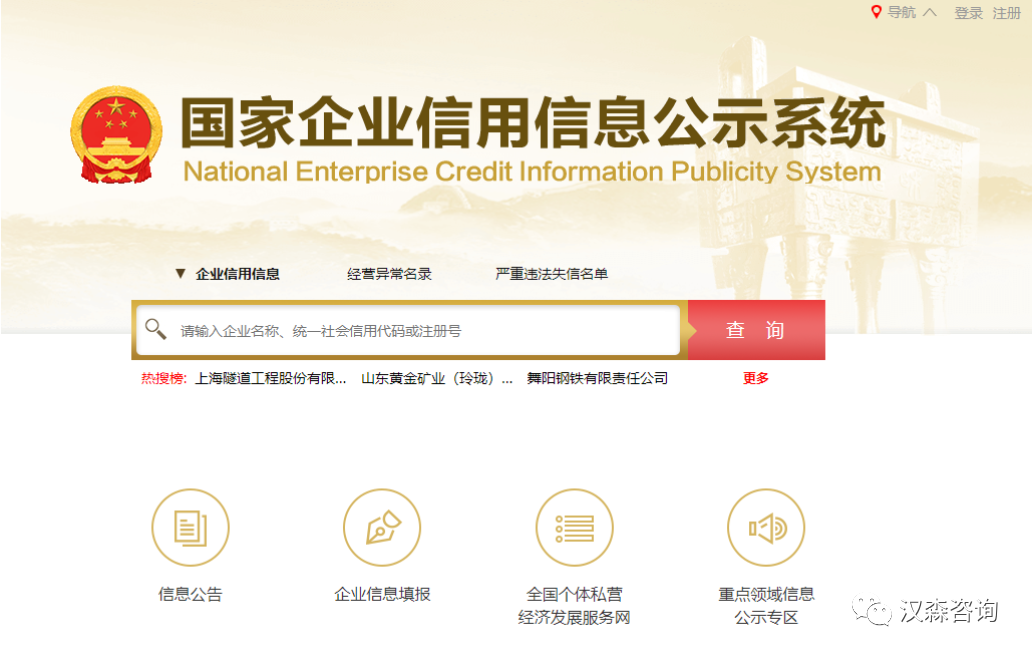
The system replaced the legacy joint annual inspection previously managed by foreign economic and trade commissions, industry and commerce, customs, statistics, finance and foreign-exchange authorities. It consolidates the foreign-invested-enterprise joint annual inspection and the AIC annual inspection into a single platform, publicising approximately 75% of an enterprise's legal, economic, financial and personnel data.
Credit Publicity Platform of Import and Export Business of Customs (中国海关企业进出口信用信息公示平台)

Following the implementation of the Measures of the PRC Customs for the Credit Administration of Registered and Filed Enterprises on 1 November 2021, the number of customs Advanced Certified Enterprises has grown steadily.
Provincial credit centres (e.g. Zhejiang)
In 2018, Zhejiang became the first province to launch a public credit-information platform — "Credit China · Zhejiang Credit Centre" — in response to the State Council's Outline of the Social Credit System Construction Plan (2014–2020). The platform aggregates credit ratings assigned by multiple government departments across all Zhejiang-registered enterprises and publishes "red" and "black" lists. A single query surfaces an enterprise's full social-credit picture.
These are only a subset of CSCS sub-systems. Another major component — and the one most directly relevant to corporate finance and tax functions — is the Tax-payment Credit Rating System.
Tax-payment Credit Rating
The enterprise tax-payment credit rating was first proposed in 2003 and consolidated by the State Administration of Taxation (SAT) in 2018 into a five-tier scale: A, B, M, C, D.
- Grade A (highest). Each year the SAT publishes the list of Grade A enterprises. These enterprises enjoy priority access to the latest tax incentives, a "green channel" for tax procedures, and various incentives coordinated across multiple government departments.
- Grade D (lowest). Names are likewise published. Government departments — tax, AIC, customs, banks, foreign-exchange — apply heightened oversight, raise the documentation bar for routine filings, and place the enterprise on a key-inspection list. A downgrade materially increases administrative, financial and legal friction across the business.
Since 2018, the rating has been assessed annually by local tax bureaus in April of the year following the relevant accounting period (excluding branches that do not file independently). Enterprises can view their rating and any point deductions on the e-tax bureau portal.
What enterprises should do
Enterprises should review the full scope of the tax-credit-rating indicators and self-check all related items: whether all bank accounts, accounting books and accounting systems are correctly filed and promptly updated on the e-tax portal; whether financial statements are submitted on time. A downgrade can affect cash flow, sales and operations. In some cases the trigger is not a deliberate act but a procedural oversight — or even a system issue.
Example. Enterprise A's e-tax-bureau profile recorded monthly financial-statement filing as the default, while in practice the taxpayer and the responsible tax officer had agreed to quarterly filing. The e-tax system did not flag the missed filings as overdue, and the enterprise missed several periods. The local tax bureau downgraded the enterprise from Grade B to Grade C for late filing of financial statements. A customer of the enterprise, on seeing the downgrade in its own banking portal, refused to continue the business relationship until the rating was restored to Grade B or above.
A common practical pitfall: information held by tax and banking systems is not fully aligned. Although tax authorities can view a taxpayer's bank-account information, the data does not auto-register on the tax side. New bank accounts still need to be declared proactively; if missed, the inconsistency results in credit-score deductions. Many enterprises have been penalised for such omissions, despite no intent to mislead.
Practical recommendations
As the cases above illustrate, an enterprise that files and pays on time can still see its rating reduced by a small oversight or system issue. The strictness of local tax bureaus in scoring and review varies. We recommend that enterprises review every indicator published by their local tax bureau to avoid a sudden downgrade and the operational consequences that follow.
It would also be helpful if the relevant authorities, when designing new policies and systems, considered the practical operating context of enterprises and strengthened inter-departmental communication — for greater transparency, lower friction, and substance over form — supporting enterprise efficiency and economic growth.
Conclusion
Chinese enterprises are entering an era of large-scale credit data and the forthcoming Golden Tax Phase IV will further strengthen monitoring. CSCS — and the tax-payment credit rating in particular — is directly tied to day-to-day operations. We recommend that management incorporate the tax-credit-rating indicators into their enterprise risk-management and internal-control procedures.
Hendersen's teams stand ready to support clients with credit-rating assessments covering tax, customs and other digital credit systems, and to propose remediation plans so that enterprises are well prepared for any future credit-rating implications.
Related insights
- 2026-09-09Lessons Learned from the Wesley Trust Case and the Interpretation of the New Domestic Circular No. 21
- 2026-08-27State Taxation Administration Issues Document Clarifying Collection and Administration Issues Concerning Income Tax Treatment of Enterprise Reorganization
- 2026-07-27【BREAKING】New Offshore Trust Rules