
Insights · 2023-07-21
Permanent establishment risk points — lessons from two recent cases

By Kevin and Judy
The determination of permanent establishment (PE) remains one of the most contested issues in cross-border tax practice. With cross-border economic activity now constant, both domestic law and international double-tax treaties must be considered.[1]
Background
PE is a foundational concept in international tax law. Whether a PE exists determines which contracting state has the right to tax the business profits of an enterprise of the other contracting state at the corporate income-tax rate of 25%.
The legal basis for PE determination is primarily the bilateral tax treaty between the foreign enterprise's country of residence and China. Many of these treaties were concluded decades ago, and relying on the treaty alone is rarely enough. This article examines two recent cases to highlight the risk points that enterprises tend to overlook and the need for a careful approach to PE exposure in China.
A limited partner (LP) can be thought of simply as an investor. In past practice, distributions received by an LP from a partnership were subject to a 10% withholding on corporate income tax. However, in a case disclosed in May 2023, the foreign entity was held to constitute a PE, and the distributions were taxed at 25% — a material increase in the tax burden.
A general partner (GP) is typically found in investment vehicles — private-equity funds, hedge funds and venture-capital firms. The GP is essentially the internal decision-maker: it makes investment decisions and manages the vehicle, contributing only a small amount of capital.
Case 1: Limited partner treated as a PE in Fuzhou
The official notice from the Fuzhou tax authority is reproduced below (excerpted and lightly edited for clarity):
Tax Matters Notice — Gudong Tax Sub-bureau, Gulou District Tax Bureau, Fuzhou, SAT
Ref: Rong-Gu-Shui-Gu-Dong-Tong [2023] No. 144
Yimei Co., Ltd. (Tax ID: F35010234401364)
Subject. Your company declared RMB 18.967 million of distributions received from Fujian Haixia Gaomei Equity Investment LP as dividends, withholding RMB 1.897 million at source under the dividends regime. This filing was incorrect. The amount should have been subject to corporate income tax at 25%.
Legal basis. Article 9 of the Announcement on Issues Concerning Withholding of Corporate Income Tax at Source for Non-resident Enterprises (SAT Announcement [2017] No. 37).
Notification. On review, your company is held to constitute a permanent establishment in the PRC. The RMB 18.967 million received from Fujian Haixia Gaomei Equity Investment LP should be filed as business income with the in-charge tax office (Gulou District Tax Bureau, Fuzhou, Fujian Province, SAT) and subject to corporate income tax at the location of the PE. The original RMB 1.897 million withheld by the partnership was filed as dividend income at the wrong tax category and rate. You are required to attend the in-person tax hall (49 Bayiqiuzhong Lu, Gulou District, Fuzhou, Fujian) within 15 working days of receiving this notice to amend the filing and pay the additional tax of RMB 28.4505 million.
Contact: Chen XX · Tel: 180-XXXX-XXXX
Issued by Gudong Tax Sub-bureau, Gulou District Tax Bureau, Fuzhou, SAT — 29 May 2023.
Analysis
The published information does not specify which type of PE the Hong Kong entity (Yimei Co., Ltd.) was held to constitute. The amounts involved are material, however, which makes the case especially worth discussing.
The simplified ownership structure of the partnership is as follows:
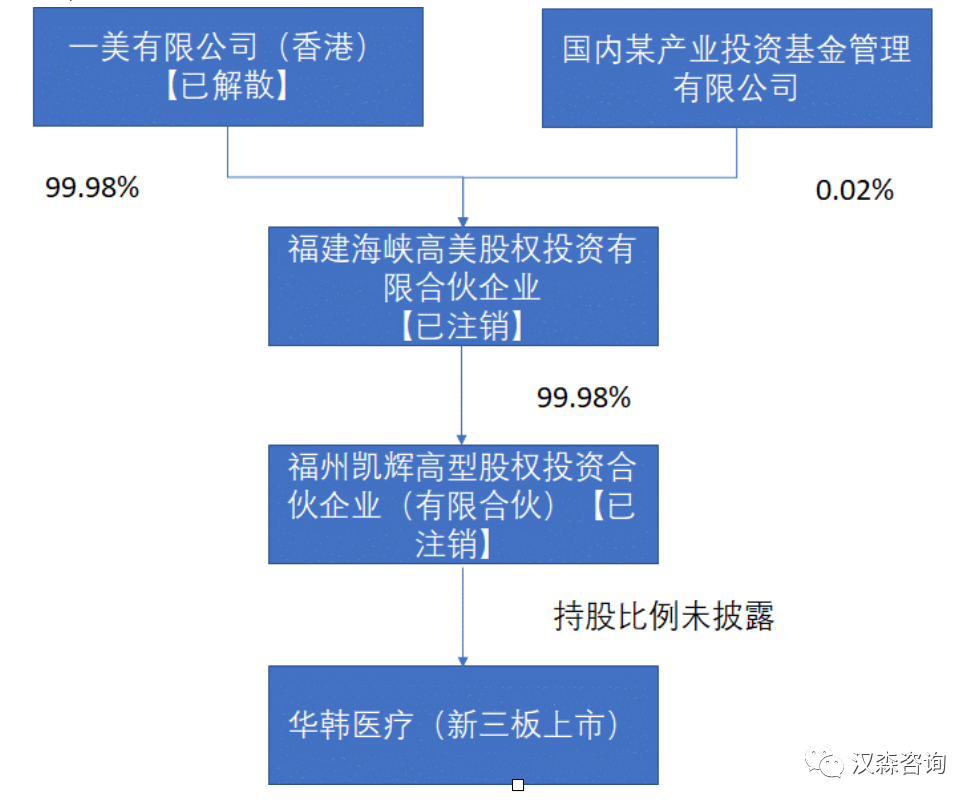
According to the Fuzhou tax bureau's notice, the limited-partner distributions were taxed at 25% on the basis that a PE existed, and the 10% withholding rate on passive China-source income available to non-resident enterprises was not applicable.
Past typical cases include the China branches of foreign banks held to be PEs in China, and GPs of partnerships taxed at progressive rates on business income (up to 35% IIT) rather than the flat 20% rate.
One hypothesis is that Yimei was held to constitute a service PE: where an enterprise of one contracting state, through employees or other personnel, provides services — including consultancy services — in the other contracting state for the same or connected projects. Under the Mainland–Hong Kong tax arrangement, the threshold is any twelve-month period (continuous or cumulative) of more than 183 days.
In practice, the days worked in China are computed by accumulating the period from the first entry to the last departure. Detailed calculation rules have not been formalised, so some bureaus simply count the entire period without netting out absences. For example, if the first person entered on 1 January 2023 and the last person left on 20 July 2023 — even with gaps during which no one was in China — the cumulative days could still be counted as 201, exceeding the 183-day threshold. Whether the Hong Kong company's various China investment projects are commercially connected, requiring their respective days-in-China to be aggregated, is another contested point. PE risk of this kind should be discussed carefully with the tax bureau.
The above is a high-probability hypothesis; other PE categories are not excluded. We have also seen online commentary pointing to tax-risk issues in the Hong Kong company's equity structure. We do not pursue those here due to length.
It is worth noting that the new commercial models arising from the digital economy have given the OECD/G20 BEPS Action Plan meaningful traction: it seeks to redefine international tax rules so that they catch up with how enterprises actually operate today. While China has reserved on certain BEPS multilateral-instrument provisions in its domestic legislation, Chinese tax authorities in practice already take BEPS considerations into account and exercise caution in PE determinations, drawing on the BEPS framework to some extent.
Case 2: Cross-border technical service fee disguised as offshore
A mainland internet company recently needed to pay a cross-border technical service fee. Because the counterparty had no personnel entering China, the company concluded the service was entirely offshore and no Chinese CIT was due — the traditional view. After reviewing the contracts and the operating model, we tested each PE category independently. We then represented the enterprise in pre-filing discussions with the tax bureau to obtain a preliminary view and negotiated an agreed profit margin with the counterparty, allowing the company to file and pay tax on a defensible basis. This avoided the risk of subsequent adjustments, late-payment surcharges and penalties.
Common PE categories under China's bilateral tax treaties
- Fixed-place PE. A relatively fixed place of business. Facilities used solely for storage, display or delivery of the enterprise's own goods, or for preparatory or auxiliary activities for the head office, do not constitute a fixed-place PE — but the taxpayer must be able to evidence the preparatory/auxiliary nature to the in-charge tax bureau, which makes the determination.
- Construction PE. Building sites, construction, assembly or installation projects, and related supervisory activities. The threshold is typically 6 to 24 months, depending on the specific bilateral tax treaty.
- Service PE. Services — including consultancy — provided in the other contracting state by an enterprise of one contracting state through its own employees or other personnel for the same or connected projects. The threshold is typically more than 6 months or 183 days (continuous or cumulative) in any twelve-month period; some treaties specify 12, 18 or 24 months.
- Agency PE and others.
Closing remarks
In practice, the gap between the legal text and the day-to-day operation of these rules is significant. Achieving an optimal tax outcome and minimising risk requires precision at every step: policy interpretation, business characterisation, supporting evidence, process mapping and the e-tax-bureau filing itself.
PE is far from a settled topic. In practice it remains a live and constantly evolving issue.
[1] This article uses "tax treaties" as a general term covering both comprehensive double-tax agreements (DTAs) and the Mainland–Hong Kong / Mainland–Macau tax arrangements.
Related insights
- 2026-09-09Lessons Learned from the Wesley Trust Case and the Interpretation of the New Domestic Circular No. 21
- 2026-08-27State Taxation Administration Issues Document Clarifying Collection and Administration Issues Concerning Income Tax Treatment of Enterprise Reorganization
- 2026-07-27【BREAKING】New Offshore Trust Rules