
Insights · 2023-08-04
Tax puzzle: when a Portuguese parent sells a Chinese subsidiary

By Frank Tao
When a multinational group needs to transfer — directly or indirectly — a Chinese subsidiary for any reason, management will naturally look at the tax implications. Does the transaction attract non-resident enterprise income tax? Can it qualify for the special tax treatment that defers the liability? We recently encountered a case that was both interesting and puzzling, and we share it here.
Background
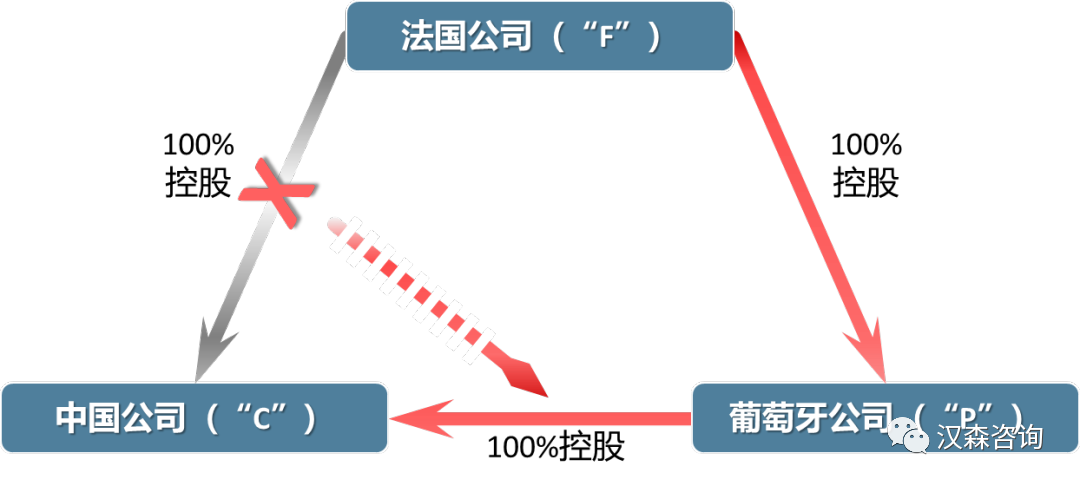
A French company, F, wholly owns a Chinese subsidiary C. F also wholly owns a Portuguese subsidiary P.
For internal reorganisation purposes, F must transfer all of its shares in C to P. P will become the sole shareholder of C, and the equity-holder recorded on C's Chinese statutory filings will need to be changed from F to P under Chinese law.
P will compensate F on a non-cash basis (the mechanics of such compensation can take many forms and are not discussed here).
Chinese tax analysis
Step 1 — Is the gain taxable in China?
The transfer by French company F of the shares in Chinese company C is a gain "derived from sources within China" by a non-resident enterprise that has no establishment or place of business in China, within the meaning of Article 3(3) of the PRC Enterprise Income Tax Law. The applicable rate is 10%.
Step 2 — Does the China–France tax treaty preserve China's taxing right?
Article 13(5) ("Capital gains") of the China–France tax treaty (signed 26 November 2013, effective 1 January 2015) confirms that China retains the right to tax the gain. Article 13(5) reads, in substance: gains derived by a resident of one contracting state from the alienation of shares in a company that is a resident of the other contracting state (other than those covered by paragraph 4) may be taxed in that other state if the alienator held, directly or indirectly, at least 25% of the capital of that company at any time during the 12 months preceding the alienation.
Applying the more favourable of the treaty and the domestic CIT law, China clearly has the right to tax the gain.
Step 3 — Is the special tax treatment available?
The transaction is an intra-group reorganisation, so the next question is whether the special tax treatment — which defers the tax — is available. A reminder: "special tax treatment" defers tax; it does not exempt it.
For non-resident enterprises, the relevant provisions are Caishui [2009] No. 59 ("Circular 59") and SAT Announcement [2013] No. 72 ("Announcement 72"). Most of the conditions are satisfied. The sticking point is Circular 59, Article 7(1), which requires that the reorganisation "does not change the withholding-tax burden on any future alienation of the underlying equity". On the facts of this case, that condition is not satisfied.
Article 7(1) of Circular 59 provides that the special tax treatment is available where a non-resident enterprise transfers the equity of a PRC resident enterprise to its 100% directly-held non-resident enterprise, provided that the reorganisation does not change the future withholding-tax burden on a subsequent transfer of the equity, and the transferor non-resident enterprise gives a written undertaking to the in-charge tax authority that it will not transfer the equity of the transferee non-resident enterprise within three years (inclusive).
Why the condition fails. The reason is striking. The China–Portugal tax treaty's Article 13 ("Capital gains") does not contain a provision analogous to Article 13(5) of the China–France treaty allocating taxing rights over share transfers unconnected to immovable property. Instead, Article 13 of the China–Portugal treaty has a residual clause providing that gains from the alienation of property other than that covered by paragraphs 1 to 4 "shall be taxable only in the contracting state of which the alienator is a resident". On a literal reading, this would mean Portugal has the sole taxing right and China has none. The difference between the China–France and China–Portugal treaties is illustrated below.
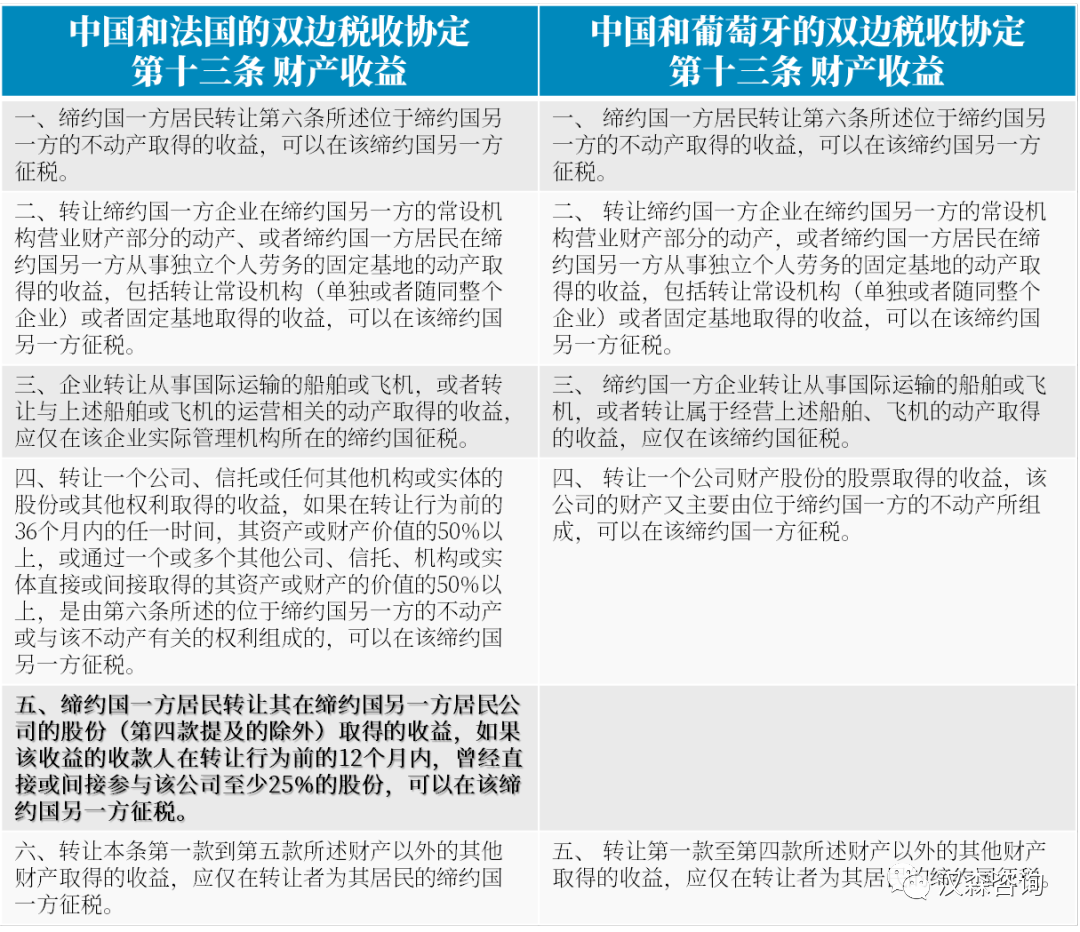
Conclusion. Applying the more-favourable rule (treaty vs. domestic law), the reorganisation from a French transferor to a Portuguese transferor does cause a change in the future withholding-tax burden. The special tax treatment is therefore not available. The gain on F's transfer of the shares in C — even though it is an intra-group reorganisation — must be taxed at 10% on the net appreciation.
Further thoughts
The interesting and somewhat puzzling part emerged as we worked through the analysis above. When a Portuguese company subsequently disposes of the Chinese subsidiary, the gain may, on the literal reading of the China–Portugal treaty, escape Chinese non-resident CIT altogether.
So in this structure, F's transfer to P does attract 10% Chinese CIT on the appreciation at that stage. But when P later exits to a third party, the further appreciation on the underlying net assets is not subject to Chinese non-resident CIT (we are looking only at the Chinese side here; French and Portuguese domestic tax and any applicable foreign tax credit are not considered). If F had instead transferred the shares directly to the third party, the entire appreciation would have been taxable in China.
A further hypothetical: if at the F-to-P stage we had failed to notice the change-in-burden issue and claimed the special tax treatment — and the tax bureau had accepted it without detailed review — the bureau might later argue, on the basis that the parties were deemed to have proceeded on the assumption of no change in withholding-tax burden, that P's subsequent exit to a third party should be taxed by reference to the French treaty at full Chinese tax, rather than the Portuguese treaty at nil.
That said, this is good news for multinational groups with a Portuguese vehicle: there appears to be a real planning opportunity to optimise intra-group reorganisations on a defensible basis. We were slightly sceptical — Portugal does seem unusual in this respect, and the point is not widely discussed in the reorganisation literature or online. We reviewed a large number of China's bilateral tax treaties and found almost no other jurisdiction whose treaty omits the analogue of Article 13(5) for share transfers unconnected to immovable property. We reached out through multiple channels to the in-charge officials at various tax bureaus (income-tax sections at different levels) to confirm the position. The responses split roughly into two camps: some officials did confirm that a Portuguese transferor does not owe Chinese non-resident CIT on a direct share transfer; others declined to give a definitive view, saying the application must be confirmed case-by-case with the in-charge officer.
In our long experience of Chinese tax practice, we often observe that there is rarely a universal answer that fits every situation. Real-world tax treatment typically requires patient, careful re-analysis for each new case. As for the Portuguese case discussed here, even as we write this note we believe there are aspects that warrant further examination. We welcome corrections and discussion from any quarter.
Related insights
- 2026-09-09Lessons Learned from the Wesley Trust Case and the Interpretation of the New Domestic Circular No. 21
- 2026-08-27State Taxation Administration Issues Document Clarifying Collection and Administration Issues Concerning Income Tax Treatment of Enterprise Reorganization
- 2026-07-27【BREAKING】New Offshore Trust Rules