
Insights · 2023-08-14
Transfer pricing: differences and tensions between customs and tax perspectives

By the Hendersen TP Team
Introduction
As economic integration accelerates, multinational groups are increasingly building and optimising global supply chains, and cross-border related-party transactions have become routine. At the same time, China's tax and customs administrations have moved from ex-ante review to ex-post management. The reasonableness of the pricing of related-party imports is now a key focus of both tax and customs scrutiny. In recent years, more and more multinationals have found themselves facing simultaneous challenges — and adjustments — to their related-party import prices from both agencies.
Multinationals must also continually reassess their commercial and procurement policies in response to a changing operating environment. Adjustments to related-party pricing policy — and the resulting changes to import prices and profitability — can themselves trigger transfer-pricing scrutiny from tax and customs.
The two perspectives
Customs. The transaction value of imported goods is the primary base on which import-stage duties and taxes are levied. Customs' concern is therefore whether the Chinese entity's import price is too low, leading to a loss of import-stage revenue.
Tax. The importer's profit, after deducting cost of purchases and expenses, is the base for corporate income tax. Tax authorities' concern is therefore whether the import price (cost of purchases) is too high, depressing the Chinese entity's profit and causing a CIT loss.
The challenge for enterprises
Because the legal bases and regulatory objectives differ, customs and tax typically apply different methods when reviewing related-party import prices. Customs tend to focus on the price (or gross margin) of the related-party import; tax authorities tend to focus on the Chinese entity's operating profit. The diagram below compares the analytical approaches used by tax transfer-pricing and customs valuation, illustrated for a related-party import.
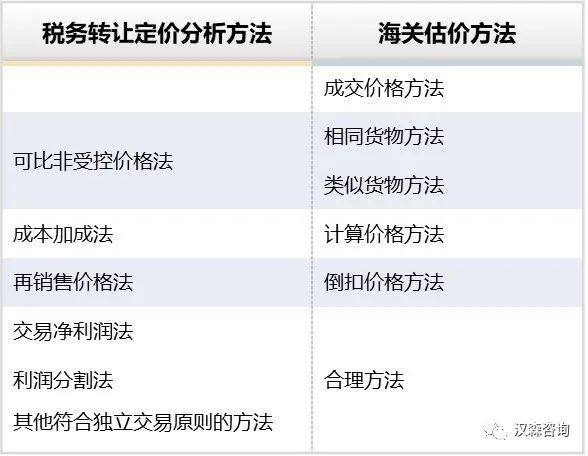
Multinationals can find themselves challenged by both sides at once. On one hand, an import price that is too low invites a customs price adjustment — and the resulting additional import duty and VAT. On the other hand, an import price that is too high depresses operating margin and triggers a transfer-pricing challenge from tax, with the corresponding CIT adjustment. Striking the right balance so that a related-party import is arm's-length under both regimes is a real practical problem for many groups.
Beyond the transfer-pricing adjustment itself, there is also a foreign-exchange compliance layer. On 19 January 2021, the State Administration of Foreign Exchange (SAFE) issued the Q&A on Foreign-Exchange Management Policy for Trade in Services (II), which for the first time set out a clear policy treatment for FX flows arising from transfer-pricing adjustments. Where an adjustment is genuine and lawful — and supported by a written document issued by the tax or customs authority in connection with the TP adjustment — the related FX receipt/payment may be processed under the original trade classification.
Coordinated customs–tax management
On 18 May 2022, the Shenzhen Tax Bureau and Shenzhen Customs jointly issued the Announcement on Implementing Coordinated Transfer-Pricing Management for Related-Party Imports (the "Announcement"). Drawing on the customs pre-ruling system and the tax Advance Pricing Arrangement (APA) regime — and without breaking either set of existing rules — the Announcement is the first attempt to combine the two frameworks procedurally, introducing cross-departmental coordination: joint review, mutually recognised outcomes, and a written three-party memorandum signed by the enterprise, the tax bureau and customs that locks in the agreed result in advance. The mechanism resolves the long-standing problem of dual price-determination and double taxation on related-party imports and brings meaningful certainty to TP management. It is a milestone initiative — not only in China but globally.
The template memorandum released alongside the Announcement sets out twelve articles, including general definitions, scope, period of application, critical assumptions, transfer-pricing and customs-valuation methods, applicant price adjustments and annual reporting. Several items are particularly worth highlighting.
Period of application. Three calendar years.
TP method and customs-valuation method. The TP method, the customs-valuation method, the financial indicators used and the agreed arm's-length range must all be specified in the memorandum.
Applicant price adjustments. The enterprise must ensure that, in any year, the actual financial indicator falls within the agreed arm's-length range around the median. If actual results fall outside the median, the enterprise must adjust the price to the median, with customs and tax each following their respective procedures.
Critical assumptions. Following the template used for tax APAs, the memorandum sets out the critical assumptions regarding internal and external factors that could materially affect the agreed price. If any of these assumptions change, the enterprise must report in writing to the in-charge customs and tax authorities within 30 days, and the memorandum may be revised or terminated by mutual agreement.
Closing
The Announcement gives Shenzhen-based enterprises an effective TP-management tool, helping resolve transfer-pricing issues on related-party imports under both customs and tax and reducing compliance cost. The mechanism is currently being piloted in Shenzhen and applies only to enterprises under the jurisdiction of Shenzhen Customs and the Shenzhen Tax Bureau. As implementation progresses, further refinements and reconciliation between customs and tax rules are likely. We are following the practical implementation closely and hope to see the mechanism rolled out to other provinces and cities as soon as possible.
If you would like to discuss transfer-pricing topics further, please contact our TP services team.
Related insights
- 2026-09-09Lessons Learned from the Wesley Trust Case and the Interpretation of the New Domestic Circular No. 21
- 2026-08-27State Taxation Administration Issues Document Clarifying Collection and Administration Issues Concerning Income Tax Treatment of Enterprise Reorganization
- 2026-07-27【BREAKING】New Offshore Trust Rules