
Insights · 2023-12-20
Rethinking restructuring tax: is special tax treatment always the better choice?

By Judy Gu and Allen Yu
"In this world nothing can be said to be certain, except death and taxes." — Benjamin Franklin
Why the question matters
In a business environment shaped by accelerating geopolitical and market change, corporate restructuring — through merger, spin-off, disposal or share swap — has become routine. Tax is invariably a major consideration. Management must design the structure carefully to minimise the legitimate tax cost and the compliance risk that comes with it.
A common assumption on management teams is that the special tax treatment under Caishui [2009] No. 59 ("Circular 59") is always the optimal answer. It isn't always — and in some cases, the general tax treatment produces a better outcome. This article illustrates why, using two short case studies.
What the special tax treatment actually is
Where a restructuring satisfies the conditions in Circular 59, the transferring taxpayer does not recognise gain on the transfer or exchange of assets, and the tax base of the relevant assets and shares carries over unchanged. The result is a deferral of CIT — not an exemption. Note also that the special tax treatment under Circular 59 covers CIT only; other taxes (VAT, land VAT, deed tax, stamp duty) need to be considered separately.
The regime places particular emphasis on two tests:
- Economic substance. The restructuring should not change the shareholders' underlying economic interests — it should optimise resource allocation, not transfer ultimate ownership. The pre- and post-restructuring positions should be substantively the same, with only the form changing.
- Continuity of interest and continuity of business. The shareholder or transferor must retain a continuing stake in the receiving entity (Circular 59 specifies a minimum equity percentage and a holding-period requirement — typically 12 months, and three years for cross-border transactions), and the receiving entity must continue to operate the business; it cannot sell or dispose of the relevant assets shortly after the restructuring.
These conditions make special treatment attractive on the face of it, but the right answer still depends on the enterprise's facts: the restructuring form, the availability of unused tax losses, any preferential-rate exposure and so on. The post-restoration "clawback" mechanics also need to be understood.
Case 1 — Same-control subsidiary merger
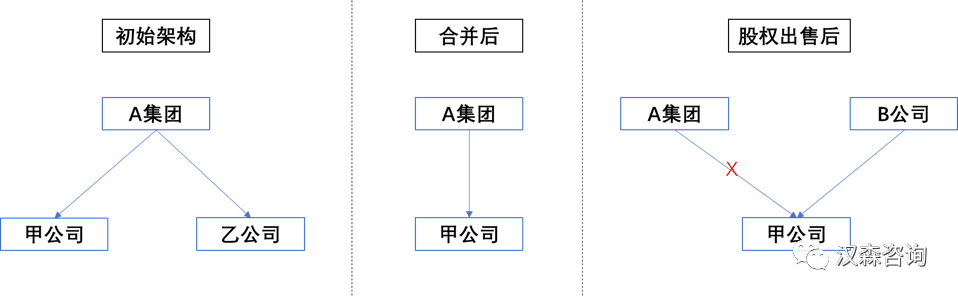
Group A wholly owns two subsidiaries, Jia and Yi, each with registered capital of RMB 10 million. To adapt to a changing market, Jia absorbs Yi in a statutory merger; Jia is the surviving entity. On the merger date, Yi's book value (and fair value) is RMB 60 million. Group A itself has unused prior-year tax losses of RMB 50 million, all due to expire within one year.
A year after the merger, Group A sells the shares in Jia to Company B.
Assume that the merger qualifies under Circular 59, and Group A can elect either treatment.
Option 1 — Special tax treatment
Because Jia and Yi are both wholly-owned by Group A, Group A can carry over its original RMB 10 million cost basis in Yi and defer the RMB 50 million of gain (60 – 10) at the merger date. No CIT is payable at the merger date.
Two consequences then play out:
- Losses expire unused. Group A has been loss-making for years and has RMB 50 million of unused losses due to expire within one year. Because the merger under special treatment produces zero taxable income, those losses cannot be absorbed and will lapse.
- Step-up lost on the exit. When Group A sells Jia to Company B one year later, the tax base of the Yi-derived equity inside Jia remains at RMB 10 million. If the fair value of that portion is still RMB 60 million and the sale price equals fair value, Group A recognises RMB 50 million of taxable gain and pays 25% CIT on it.
Option 2 — General tax treatment
If Group A elects general treatment, it recognises the merger gain immediately. The gain — RMB 50 million, computed as 60 million (fair value of Yi) minus 10 million (cost) — is fully absorbed by Group A's RMB 50 million of expiring losses. No CIT is payable at the merger date.
Per Circular 59, Article 4(4)(ii), both Yi and its shareholder are treated as if Yi's business were liquidated. Under Caishui [2009] No. 60, Article 5, the shareholder first recognises a dividend equal to Yi's accumulated retained earnings and surplus reserve (tax-exempt under the participation exemption) — assume RMB 5 million — and the balance is investment-transfer gain. In our facts, that balance is RMB 4.5 million (60 – 10 – 5), not RMB 5 million; this reduces the headline gain but does not change the conclusion: the entire gain is absorbed by Group A's expiring losses.
A year later, when Group A sells Jia to Company B, the tax base of the Yi-derived equity inside Jia is the fair value at the merger date — RMB 60 million — because general treatment applied. If the fair value remains RMB 60 million at the time of sale, there is no gain and no CIT.
Take-away. On the merger alone, the two treatments look comparable in tax terms. Once the parent's expiring losses and the downstream disposal are taken into account, general treatment can be materially better — the losses are absorbed, and the future exit generates no additional CIT.
Case 2 — Non-control share swap with an onward sale
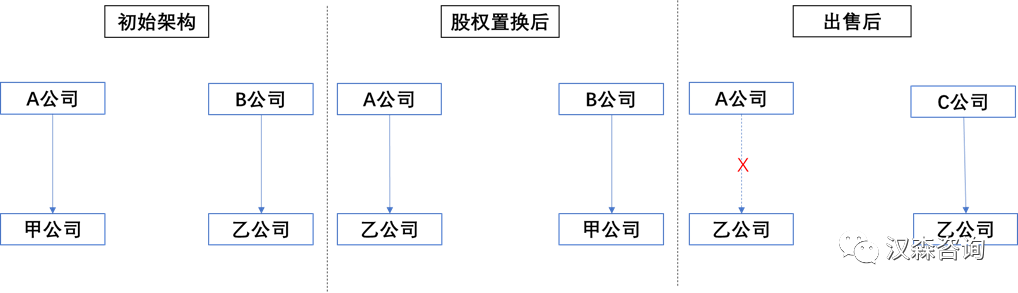
Company A wholly owns Jia (registered capital RMB 5 million). To fund a strategic acquisition of Yi (wholly owned by Company B; registered capital RMB 10 million) without using cash, A and B agree on a share swap. On the swap date, both Jia and Yi have book value and fair value of RMB 20 million. After the swap, A wholly owns Yi and B wholly owns Jia. A and B are unrelated, as are Jia and Yi before the swap.
Eighteen months later, A sells Yi to Company C for RMB 30 million (book value and fair value of Yi on that date are RMB 30 million; Jia is also at RMB 30 million fair value / book value).
Assume the swap qualifies as a Circular 59 share-acquisition transaction (an equity-for-equity acquisition of control).
Option 1 — Special tax treatment
Under Circular 59, Article 6(2), the tax base of the equity received by B (the share-consideration side) is the original tax base of the shares given up (Yi), i.e. RMB 10 million. The tax base of the equity received by A (Yi) is also the original tax base of the shares given up (Jia), i.e. RMB 10 million. The acquirer's tax base carries over.
When A sells Yi to Company C eighteen months later, all of the appreciation from RMB 10 million (original cost) to RMB 30 million (sale price) crystallises in A's hands — the original 20 million of appreciation that was deferred at the swap date becomes taxable now.
Option 2 — General tax treatment
Under general treatment, the swap itself is a taxable event. A recognises gain on the Jia shares given up; B recognises gain on the Yi shares given up. The appreciation of RMB 10 million on each side is taxed at the swap date. The taxable base of Yi's shares inside A is stepped up to fair value (RMB 20 million).
Eighteen months later, when A sells Yi to Company C, A only recognises gain on the post-swap appreciation — RMB 10 million (30 – 20).
Take-away. Special treatment defers tax but deferral is not saving when the same gain eventually crystallises in A's hands. General treatment steps up the base, so a subsequent disposal is taxed only on the post-swap appreciation. The two treatments can lead to the same lifetime CIT but with very different cash-flow and reporting profiles.
Other taxes
CIT is only part of the picture. In Case 1, choosing special treatment means Jia succeeds to Yi's assets, liabilities and labour as a whole. Because no VAT output is declared on the merger, Yi's unutilised input VAT cannot be carried forward into Jia and must be written off (transferred into cost). VAT, land VAT, deed tax and stamp tax all need separate analysis.
Filing and documentation
Both treatments trigger a "chain-style" filing obligation: in the year the restructuring completes (and, for special treatment, in subsequent years), the taxpayer must file a restructuring disclosure with the annual CIT return within the finalisation period. Enterprises electing special treatment should expect the in-charge tax bureau to scrutinise the substance of the restructuring, and to maintain continuous documentation thereafter.
Conclusion
The two case studies show that special tax treatment is not always the better answer. It can defer tax, but it can also waste expiring losses, leave a low tax base for a future exit, or simply shift the same gain to a later period. We recommend that management look beyond the immediate parties to the restructuring and consider the whole economic group — including unused losses, exit plans and the cash-flow profile over the holding period — before deciding. The general treatment is not the "fallback"; it can be the better choice.
For advisory on cross-border or domestic restructurings, please contact our tax team.
Disclaimer. This note is for general information only and does not constitute professional advice for any specific matter. No liability is accepted for any loss arising from reliance on this content. If you would like to discuss any issue raised here, please contact us by email.
Judy Gu / Allen Yu — Hendersen Taxand
Related insights
- 2026-09-09Lessons Learned from the Wesley Trust Case and the Interpretation of the New Domestic Circular No. 21
- 2026-08-27State Taxation Administration Issues Document Clarifying Collection and Administration Issues Concerning Income Tax Treatment of Enterprise Reorganization
- 2026-07-27【BREAKING】New Offshore Trust Rules