
Insights · 2025-06-19
Tightening CRS information exchange — how should China tax residents declare offshore income and claim foreign tax credit?

1. Risk and compliance in the age of tax data analytics
Case 1 — Shanghai resident Mr Chen
Tax data analytics flagged Mr Chen as having undeclared offshore income. After receiving policy guidance, Mr Chen cooperated with the in-charge tax bureau, completed the supplementary filing and paid RMB 184,800 in tax plus late-payment surcharge.

Case 2 — Shandong resident Mr Zhang
Mr Zhang held offshore financial assets over the long term but failed to declare the related interest and dividend income in time. He was identified as a key risk-monitoring target by the system and ultimately paid RMB 1,263,800 in back-taxes and late-payment surcharges, making the case one of the more high-profile individual offshore-income reviews of recent years.
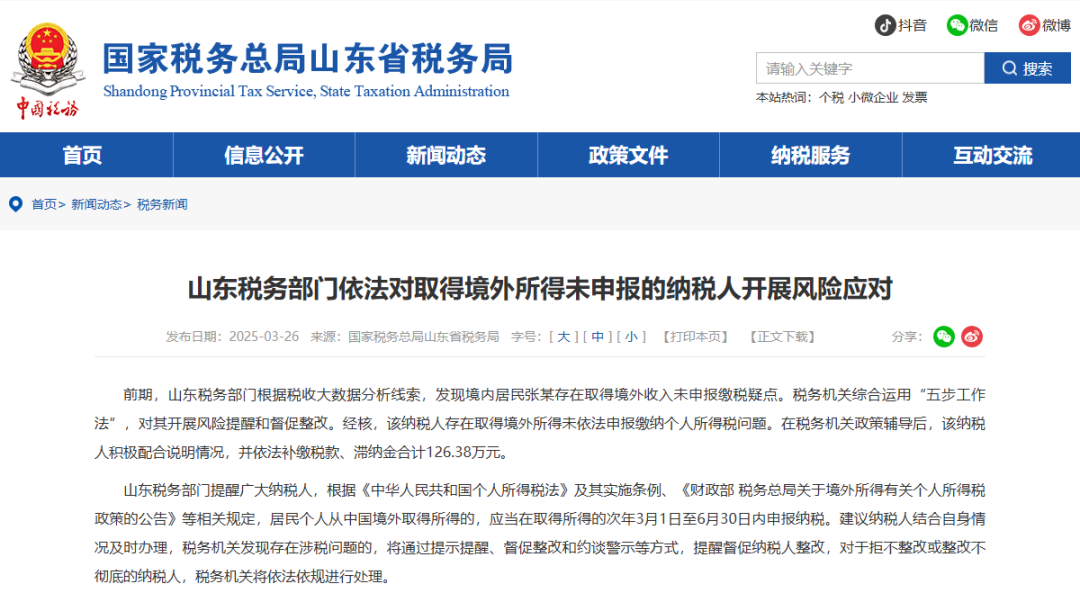
Analysis
Under the PRC Individual Income Tax Law (2018 revision):
- Article 2: a resident individual is subject to IIT on income derived from both inside and outside China.
- Article 6 sets out the scope of comprehensive and category-based income, including wages and salaries, author's remuneration, royalties, interest, dividends and capital gains.
In recent years, China's tax authorities — leveraging the Golden Tax Phase IV system and cross-departmental data sharing — have built a much broader and more precise risk-identification capability.
Categories of offshore income requiring particular attention
Dividends.
- Where an individual invests in Hong Kong-listed Mainland enterprises (e.g., H-share companies) through the Stock Connect mechanism, the relevant settlement entity withholds IIT at 20% on the dividend.
- Where the investment is in non-China-incorporated companies (e.g., a Hong Kong local company) made directly through a Hong Kong securities account, the individual must self-declare and pay IIT at 20%.
Capital gains on equity trading (US shares, HK shares, etc.)
- Taxed as "income from property transfer" at the IIT rate of 20%.
- Tax payable = (sale price − acquisition price − reasonable expenses) × 20%.
PRC residents with offshore income are advised to file honestly and, where necessary, consult a tax professional to fulfil their filing obligations in line with the law.
2. The era of global financial-information exchange is here
The Common Reporting Standard (CRS) is an international standard for the automatic exchange of tax information developed by the OECD from 2014. Its core purpose is to combat cross-border tax evasion and money-laundering, and to enhance tax compliance. Through CRS, China's tax authorities can obtain detailed information on Chinese tax residents' overseas accounts — balances, interest, dividends, equity, trusts and more — directly from partner jurisdictions.
As of now, more than 100 jurisdictions have signed on to CRS — including traditional "wealth safe harbours" such as Hong Kong, Singapore, Switzerland, Luxembourg and Liechtenstein, as well as traditional shell-company domiciles such as the Cayman Islands, the British Virgin Islands, Bermuda and Jersey.
It is worth noting that the United States has not joined CRS, but signed a bilateral FATCA agreement with China in 2014, providing a parallel bilateral information-exchange mechanism.
3. Foreign-tax-credit and consolidated-filing challenges for offshore income
Under SAT Announcement [2019] No. 35 and related rules, China tax residents earning certain categories of offshore income (such as wages, interest and dividends) can claim a credit in China for tax already paid abroad — provided the foreign tax has actually been paid and the supporting documentation passes formal review.
For some categories, however, there is still no specific credit guidance — for example, year-end bonuses and stock-option income. In practice, if the taxpayer did not have any China-side withholding on a year-end bonus during the year, it can be difficult to apply the favourable bonus tax-rate schedule (currently available through 31 December 2027) when later declaring offshore income. Stock-option income from an offshore employer, where no prior recordal has been made, is often required by the tax bureau to be folded into comprehensive income for the year and claimed there against any foreign tax paid, with the result depending on the form and verifiability of the foreign tax receipts.
Practical recommendations
- For offshore income, obtain complete and compliant tax documentation (original in English + Chinese translation).
- Where possible, claim the credit through the annual IIT settlement (1 March – 30 June each year).
- For multi-jurisdictional income, first confirm whether a Double Tax Agreement (DTA) applies and how taxing rights are allocated.
4. Proactive compliance is the best strategy
As CRS deepens and tax-administration technology continues to upgrade, the "information wall" around offshore assets is steadily breaking down. For China tax residents with cross-border investments and income, compliant declaration of offshore income is no longer optional. We recommend:
- Review your own and your family members' offshore accounts, assets and income in a timely manner.
- For complex cross-border tax arrangements, seek assistance from a professional tax adviser.
- Declare and plan in accordance with the law — and avoid the late-payment surcharges and potential legal exposure that come from non-compliance.
For assistance with the annual offshore-income filing and multi-jurisdiction foreign-tax-credit calculations, please contact our tax-compliance team.
Related insights
- 2026-09-09Lessons Learned from the Wesley Trust Case and the Interpretation of the New Domestic Circular No. 21
- 2026-08-27State Taxation Administration Issues Document Clarifying Collection and Administration Issues Concerning Income Tax Treatment of Enterprise Reorganization
- 2026-07-27【BREAKING】New Offshore Trust Rules