
Insights · 2025-09-19
A new era for platform-economy taxation in China: unpacking Announcement 16

On 26 June 2025, the State Administration of Taxation (SAT) released two companion announcements that together establish the new framework for platform-economy taxation in China:
- SAT Announcement [2025] No. 15 — Announcement on the Reporting of Tax-Related Information by Internet Platform Enterprises (the "Announcement 15"), effective 26 June 2025.
- SAT Announcement [2025] No. 16 — Announcement on Several Matters Concerning Withholding and Agency Filing of Tax by Internet Platform Enterprises for Workers on the Platform (the "Announcement 16"), effective 1 October 2025.
Announcement 15 builds a structured tax-information reporting regime for platforms, leveraging data sharing and technology to enhance supervision. Announcement 16 sets out the policy for platforms to act as withholding agents for individual IIT and to file VAT on behalf of platform workers — refining the IIT withholding method, clarifying the boundary between labour-service remuneration and business income, and easing compliance burden for workers by removing duplicate reporting. Together, the two announcements form a complete supervisory and compliance framework for e-commerce sellers and livestream hosts.
Against this backdrop, Douyin (TikTok's Chinese counterpart) recently issued new withholding rules aligned with Announcement 16, covering personal cash-withdrawal withholding, the scope of taxable income, and the platform worker's reporting obligations. Below we walk through the key points of Announcement 16, with reference to Douyin's implementation.
1. New IIT withholding method on labour-service remuneration
Under the existing rules, withholding on labour-service remuneration uses a 20%–40% progressive schedule, with tax withheld at source each time income exceeds RMB 800; the worker then settles in the annual IIT finalisation (March–June of the following year).
Announcement 16 changes this. Platforms may now use the cumulative withholding method — apply the standard monthly RMB 5,000 basic deduction and the seven-bracket progressive schedule at 3%–45%, matching the method used for comprehensive (wage) income.
2. Distinguishing labour-service remuneration from business income
Labour-service remuneration received by workers from platform enterprises is generally defined to include income from the following activities carried out on the platform for profit: livestreaming, education, medical services, delivery, domestic services, tutoring, travel, consulting, training, brokering, design, performance, advertising, translation, agency services, promotion and technical services.
Under Douyin's new host-withdrawal rules — which implement Announcement 16 — the platform withholds on livestream income, including livestream tips/donations, video creation income (e.g., partner programme, Star Map and brand-deal income), but not on referral commissions paid to a host by a merchant. The reason: Announcement 16 covers income the worker earns from the platform; merchant commissions are paid by the merchant and should be withheld by the merchant as the withholding agent, not by the platform.
Business income is the residual category: income earned by un-registered platform operators and workers from selling goods or providing transport services through the platform is treated as business income.
3. VAT treatment and agency-filing rules
For service income a worker receives from a platform, the platform files VAT and surcharges on the worker's behalf under Announcement 16.
- VAT. The worker's service income qualifies for the small-scale taxpayer exemption (monthly sales under RMB 100,000) and the 1% concessionary VAT rate, in line with prevailing policy. The RMB 100,000 threshold is tax-exclusive — equivalent to RMB 101,000 inclusive at the 1% rate. Below this, no VAT is due.
- Surcharges. Urban maintenance and construction tax (1% / 5% / 7%, depending on location), education surcharge (3%) and local education surcharge (2%). Small-scale taxpayers can apply the half-rate "six taxes and two fees" reduction.
- Crossing the small-scale taxpayer threshold. Where a worker's cumulative service income from a single platform exceeds RMB 5 million over 12 months (the deemed threshold for general-taxpayer status), the platform must guide the worker to register as a market entity and self-file VAT going forward.
- Overseas workers. Where an overseas worker earns service income from a Mainland platform, the Mainland platform acts as the service purchaser and must withhold VAT.
4. Workers earning from multiple platforms
Where a worker receives service income from two or more platforms in a month and the total exceeds the VAT exemption threshold, the tax authority pre-fills the data and pushes a confirmation-based consolidated filing to the platforms via the tax information system by the end of the month in which the platform completes its agency filing.
5. Correcting agency filings and refunds
- Current-period corrections requiring a refund — the platform applies to the tax authority.
- Prior-period corrections requiring a refund — the platform notifies the worker, who then applies to the tax authority directly.
6. CIT deduction at the platform level
Where the platform has performed IIT withholding, agency VAT filing and paid the related taxes for a worker, the platform can use the IIT withholding return, IIT payment receipt, VAT agency-filing return and VAT payment receipt as supporting documents to deduct the labour-service remuneration paid to the worker for CIT purposes at the platform level.
The platform must perform real-name verification on the worker and obtain the worker's written consent before the agency VAT filing. It must keep supporting records — real-name verification logs, transaction details, settlement records and any other documents evidencing the substance of the transactions — and produce them on request. Where the platform fails to keep such evidence, the withholding/agency-filing receipts cannot be used as CIT-deduction supporting documents.
7. MCN-signed hosts — how the tax authority ensures withholding
When a host signs with an MCN agency, the platform settles with the MCN, and the MCN settles with the host. In this chain, the MCN is the withholding agent for the host's IIT. If the MCN fails to withhold, the host retains the obligation to self-declare.
To ensure coverage of MCN-signed hosts, Announcement 15 introduced two new information-reporting forms:
- Platform files the Relationship Table between the Platform's Livestream Talent Agencies and Online Hosts.
- MCN files the Online Livestreaming Tax-Information Reporting Table.
Together, the layered reporting closes the supervisory loop on MCN-signed hosts.
8. Common tax-violation patterns and their consequences
Online-livestreaming has grown rapidly, and tax non-compliance has grown with it. With Announcements 15 and 16 in force, the tax authority can access platform-transaction data more efficiently and pinpoint irregularities more accurately. The table below summarises the main violation patterns seen in publicly-disclosed SAT enforcement cases.
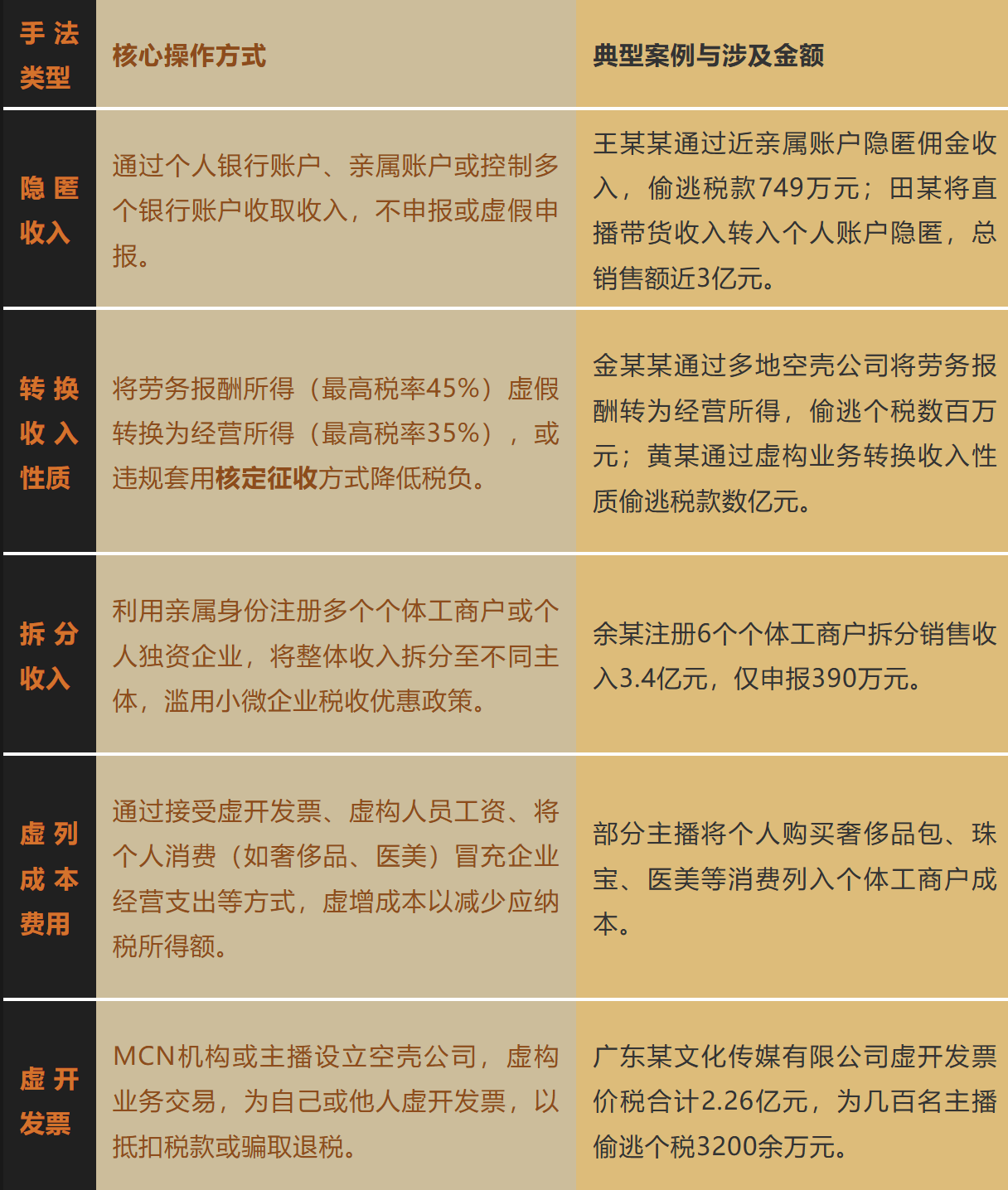
The consequences fall into three categories:
Legal. Under the Tax Collection and Administration Law, tax evasion triggers back-tax recovery, late-payment surcharge (daily 0.05%) and a fine of 50% to 5 times the underpayment. Criminal cases are referred for criminal liability.
Career. Public exposure typically destroys the host's image and reputation, leading to follower loss, contract terminations and account suspension — often ending the career.
Credit. The SAT publishes major tax-violation cases on the "black list", triggering multi-department joint sanctions: restrictions on bank loans, government procurement, and entry/exit. The SAT now widely applies "tax big data" and the latest AI techniques — cross-checking platform transactions, bank flows and invoice data — to identify anomalies efficiently. Many cases have been triggered by a clear mismatch between reported sales and reported tax; full implementation of Announcements 15 and 16 will further sharpen this capability.
Practical guidance for individual hosts
For online hosts and the agencies that work with them, compliance is the foundation of long-term development. We want to be clear: there is no legitimate "tax planning" that delivers large-scale tax avoidance in the online-livestreaming sector.
Abandon any "wing-and-a-prayer" approach. Seek professional tax advice and, within the law, identify legitimate ways to optimise the tax position. The best structural option for high-earning hosts is to incorporate a company rather than operate as an individual industrial-and-commercial household. A properly run company can convert the income character from "labour-service remuneration" to "business income" and deduct genuine business costs — but only where there is genuine substance behind the company.
On Douyin, for example, hosts can switch between personal withdrawal (default: platform withholds IIT as labour-service remuneration) and corporate withdrawal (default: treated as business/corporate income, host self-files). However, two cautions:
- Under the Opinions on Further Regulating Profit-Driven Behaviour in Online Livestreaming and Promoting the Healthy Development of the Industry (Shuizongsuodefa [2022] No. 25, jointly issued by the Cyberspace Administration, SAT and SAMR), the entities that livestreamers set up — companies or sole-proprietorship workshops — must keep proper books and apply the audit-based CIT/IIT assessment method. Deemed assessment is not available.
- If a deemed-assessment approach is taken, the tax authority may treat it as a sham conversion of income character and assess the income as labour-service remuneration. Even where the entity is a sole proprietorship with no employees or premises, the lack of substance may lead the authority to disregard the entity and reassess on a labour-service basis. The same applies to shell companies. The current enforcement environment — particularly for celebrities and high-profile hosts — applies the substance-over-form principle rigorously.
References
- Opinions on Further Regulating Profit-Driven Behaviour in Online Livestreaming and Promoting the Healthy Development of the Industry (Shuizongsuodefa [2022] No. 25), issued 25 March 2022 by the Cyberspace Administration of China, the SAT and the SAMR.
- SAT Announcement on the Reporting of Tax-Related Information by Internet Platform Enterprises (Announcement [2025] No. 15), issued 26 June 2025.
- SAT Announcement on Several Matters Concerning Withholding and Agency Filing of Tax by Internet Platform Enterprises for Workers on the Platform (Announcement [2025] No. 16), issued 26 June 2025.
Related insights
- 2026-09-09Lessons Learned from the Wesley Trust Case and the Interpretation of the New Domestic Circular No. 21
- 2026-08-27State Taxation Administration Issues Document Clarifying Collection and Administration Issues Concerning Income Tax Treatment of Enterprise Reorganization
- 2026-07-27【BREAKING】New Offshore Trust Rules