
Insights · 2026-03-17
2025 update to the OECD Model Tax Convention Commentary: a new framework for home-office PE risk

The normalisation of cross-border remote work has brought the home-office PE risk to the top of the agenda for multinational tax teams. Source-state tax authorities are increasingly questioning whether an employee's private residence counts as a "place of business" of the foreign employer — an assertion that can trigger corporate tax filing obligations and significant compliance burden in the employee's home jurisdiction.
To address this global uncertainty, on 19 November 2025 the OECD released a key update to the Commentary on Article 5 (Permanent Establishment) of the Model Tax Convention. The update does not abolish the existing principles — instead, it overlays objective, quantitative thresholds on the existing analysis, drawing a clearer line around when a personal residence or other non-employer-owned premises counts as a "place of business" of the enterprise. For multinationals and tax practitioners, this marks a move from an abstract, fact-driven test to a more predictable framework — and it is the central reference point for cross-border workforce tax compliance in 2026 and beyond.
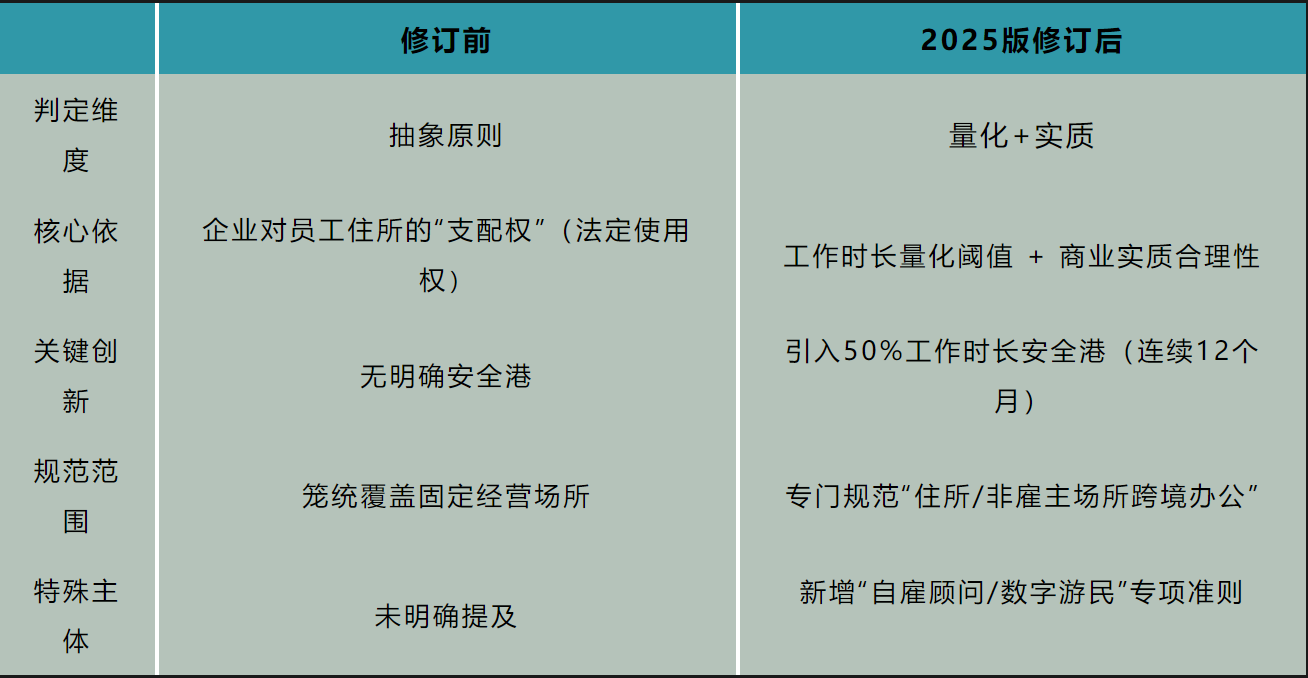
The core meaning of the update: from "control" to "quantification"
The 2025 update restructures the home-office PE framework. It replaces the highly subjective "right of use" test (did the enterprise have effective use of the employee's home?) with a dual standard of "quantitative threshold + commercial substance".
Under Article 5(1) of the Model, a PE requires three conditions: (1) a "place of business"; (2) a "fixed" place; and (3) the business of the enterprise is carried on "through" that place. Condition (3) — the "right of use" test — was historically the most contested in practice.
The 2025 update replaces paragraphs 18–19 of the Commentary with detailed guidance, recognising that personal residences, holiday rentals and friends' homes have a particular character of "restricted access and high personal autonomy". The new framework establishes a 50% time-share threshold as the principal safe harbour and commercial reasonableness as the substantive test, prioritising economic substance over formal legal rights. It gives multinationals a workable risk-management path.
The new test for whether a home-office is a PE
The 2025 Commentary treats persistence, continuity, working time and business necessity as the core dimensions, producing a "stepped" analysis.
1. Place-and-continuity requirement: persistence is the precondition
The location must satisfy both fixity and persistence — use must be continuous over a meaningful period, rather than sporadic or incidental. The updated Case A makes clear that very short-term activity (e.g., a one-week business trip) — even if repeated — lacks persistence. By contrast, three months of continuous home-working combined with the nature of the work and commercial reasonableness may cross the threshold. The OECD is careful to characterise "very short" qualitatively; it does not impose a fixed month-count limit.
2. The 50% quantitative threshold: the core safe harbour
This is the most important innovation. Under the 2025 Commentary, if, in any rolling 12-month period, the time the employee spends working for the enterprise at a non-employer-owned location is less than 50% of the employee's total working time over the same period, that location will generally not constitute a place of business of the enterprise.
The threshold gives multinationals a clear compliance perimeter, removing the need to argue over formal control indicia such as whether the company provided office equipment or reimbursed rent.
3. Commercial reasonableness test: the substantive analysis above the threshold
If the 50% threshold is exceeded, the commercial reasonableness test applies, asking whether the employee's physical presence in the source state is a necessary condition for the enterprise's business.
A. Typical cases of commercial reasonableness (likely to trigger PE)
The Commentary's Cases C and E identify several scenarios:
- Direct engagement with source-state customers — meeting clients, developing local relationships, identifying business opportunities.
- Supply-chain management — sourcing new suppliers, managing supplier relationships, supervising contract performance.
- Time-zone-driven service delivery — real-time or near-real-time service to a customer in another time zone (e.g., call centres, remote IT support, telemedicine).
- Reliance on local resources — regular engagement with source-state universities, research institutes or other local partners.
- Field-service requirements — services that require on-site delivery in the source state (e.g., training, equipment maintenance).
Example. An employee working from home in State S for 80% of their time and regularly delivering on-site services to clients in State S both meets the 50% threshold and satisfies commercial reasonableness — a PE is established.
B. Excluded cases (no PE even above 50%)
The 2025 Commentary makes clear that the following scenarios are mere "corporate management choices" without substantive nexus to the source-state business, and therefore lack commercial reasonableness:
- Talent-retention motive — home-working purely to attract or retain key staff.
- Cost-control motive — home-working purely to reduce headquarters office rent and similar costs.
- Incidental presence — presence in the country only because a customer or supplier happens to be there, or only to take advantage of time-zone differences, with no substantive business dependence.
- Zero-touch roles — fully online service delivery with no physical interaction in the source state (e.g., purely remote software development).
The self-employed-consultant rule: a specific regime for digital nomads
The 2025 update introduces a specific rule for self-employed consultants / digital nomads: if the individual is the sole or principal performer of the enterprise's business activity, and for a sustained period conducts the core business primarily from home, then that home location directly constitutes a place of business of the enterprise. The rule closes a long-standing supervisory gap and makes clear that the home-office PE risk in self-employed structures is materially higher than for employees.
The three safe harbours
In addition to the 50% threshold and the commercial-reasonableness test, the 2025 Commentary retains and clarifies three further exclusions.
1. Below 50% (the principal safe harbour)
As set out above: where the rolling-12-month time-share is below 50%, the location does not constitute a place of business — unless specific counter-evidence (e.g., the enterprise actually exercises effective control over the location) is present. Illustrative case. An employee working from home in State S one or two days per week — cumulative share 30% — meets the fixity requirement but falls below the 50% threshold; no PE arises (consistent with the spirit of the Belgium–Netherlands competent-authority agreement of 2023).
2. Preparatory or auxiliary activities (the absolute safe harbour)
Consistent with existing rules, if the home-office activity is preparatory or auxiliary within the meaning of Article 5(4), no PE arises regardless of time-share or control indicia. The 2025 Commentary confirms that the following are typical preparatory or auxiliary home-office activities:
- Internal accounting and financial-statement preparation;
- Human-resource management (e.g., recruitment, training);
- Administrative, secretarial, data-entry and filing work;
- Technical support (where not related to the core business).
3. Pure personal-preference remote work
Even where the 50% threshold is exceeded, if the home-working is driven purely by the employee's personal preference (the enterprise does not require it and there is no commercial reasonableness), PE will generally not arise.
Implications and compliance recommendations for multinationals
The 2025 update marks a shift from "formal compliance" to "substantive compliance" in PE analysis. Multinationals should adjust their cross-border workforce tax strategy along four lines:
1. Reframe the analysis: from "control" to "operational necessity"
Move away from formal indicia (equipment, expense reimbursement) and focus on:
- Quantitative monitoring — does the employee's time in the source state exceed the 50% threshold?
- Substantive assessment — is the employee's physical presence in the source state a necessary condition for the enterprise's business (commercial reasonableness)?
2. Build a quantitative monitoring system (the compliance core)
Establish a cross-border working-time tracking mechanism covering:
- Rolling-12-month aggregation of source-state home-working time;
- Segregation of core-business work vs preparatory/auxiliary work;
- Reason for the home-working arrangement (personal preference vs business need).
3. Tighten contracts and policy
- Specify in cross-border employment contracts the scope and time limits of remote work.
- Adopt a written Cross-Border Remote-Working Tax Compliance Policy with a clear 50% threshold red line and an approval workflow for any exceedance.
- Retain supporting evidence (employee applications, business-necessity justifications) for tax-authority review.
4. Classify activities precisely
Segment remote roles with discipline:
- For preparatory/auxiliary roles (finance, HR), remote work can be permitted broadly under the absolute safe harbour.
- For core-business roles (sales, customer service), strictly cap source-state working time, or establish a local entity to take on the source-state business in a compliant manner.
Related insights
- 2026-09-09Lessons Learned from the Wesley Trust Case and the Interpretation of the New Domestic Circular No. 21
- 2026-08-27State Taxation Administration Issues Document Clarifying Collection and Administration Issues Concerning Income Tax Treatment of Enterprise Reorganization
- 2026-07-27【BREAKING】New Offshore Trust Rules